By Antanas Bakšys, CEO & Co-Founder of Ace Waves
For the past year we have been quietly running customer service for some of Europe's busiest consumer brands. Millions of conversations, resolved, start to finish. We have talked about the results, but never shown the product.
Today, after two years of foundational work, we are introducing a new way to run agentic customer service: not another chatbot, not another LLM wrapper, not even another automation platform, but our own core technology – Agent Graph.
Most of those two years came down to a single observation: the hard part of AI in customer service was never answering the question – language models have been able to do that since 2023. The hard part is resolving the issue: following the business logic, checking the systems, doing the actual work across voice, chat, email or any other channel. Actually solving it correctly, rather than just deflecting it to a human agent.
But first, it is worth looking at the market, because customer service automation now means completely different things depending on who is selling it.
The three ways to build customer service AI automation
If you are buying customer service automation today, you are forced to choose between tools that deploy fast and cap early, and builds that go deep but need your engineers. All of it falls into three categories.
1. Decision-tree and rule-based bots
These are the oldest forms of customer service automation: no generative AI, no reasoning and no ability to take action in your systems. The paths are written in advance, so the bot answers the questions someone anticipated and routes everything else to a help center article or a human agent.
They are inexpensive and predictable, which is why a number of companies still run them, and they are also what most customers have in mind when they hear the word chatbot.
2. Everything built on natural-language procedures
Helpdesk chatbots sit here, but so do genuinely strong agentic platforms and custom-built LLM systems. Some are based on excellent technology, and it still does not automatically make for reliable customer service automation, because of how the procedures themselves are built.
Agent behaviour in these systems is described in natural language: one large prompt per procedure, or one prompt per agent. So every new case means writing a new prompt. Within months you are maintaining hundreds of them, quietly contradicting each other. Past a certain point, adding procedures stops adding coverage, and the quality starts degrading.
New versions of these products are released regularly, but the constraint is in the approach rather than the version, so the results do not improve significantly.
3. Engineering-heavy platforms built for large enterprises
These platforms genuinely handle complexity, but they need your engineering team working alongside the vendor, which means the result depends as much on your team's AI experience as on the platform itself. They also take three to six months to deploy, sometimes a year, and results come later still.
Once it is running, the logic lives in code, so the people who own the procedures cannot see what their own system is doing. When something goes wrong, the person who understands the policy has to ask the person who understands the code. And every change to a policy goes back through engineering, so the team closest to the customer cannot make the change themselves.
What the market misses
The problem is that none of this works for companies big enough that support is a real department rather than a shared inbox, but not big enough to have AI and engineering teams to spare.
These companies have hundreds of thousands of conversations a year, sometimes millions. They are growing fast, so they need a system that keeps working as scope expands. They need AI capable of doing real work in their systems rather than answering questions and routing to a human. And they do not have six months, or the people to do it themselves.
So we built Ace Waves for them.
Agent Graph: a new way to build AI agents for customer service
Agent Graph encodes your support procedures as an executable, visual graph of specialized agents, business rules, integrations, actions and guardrails, rather than as one large prompt per procedure.
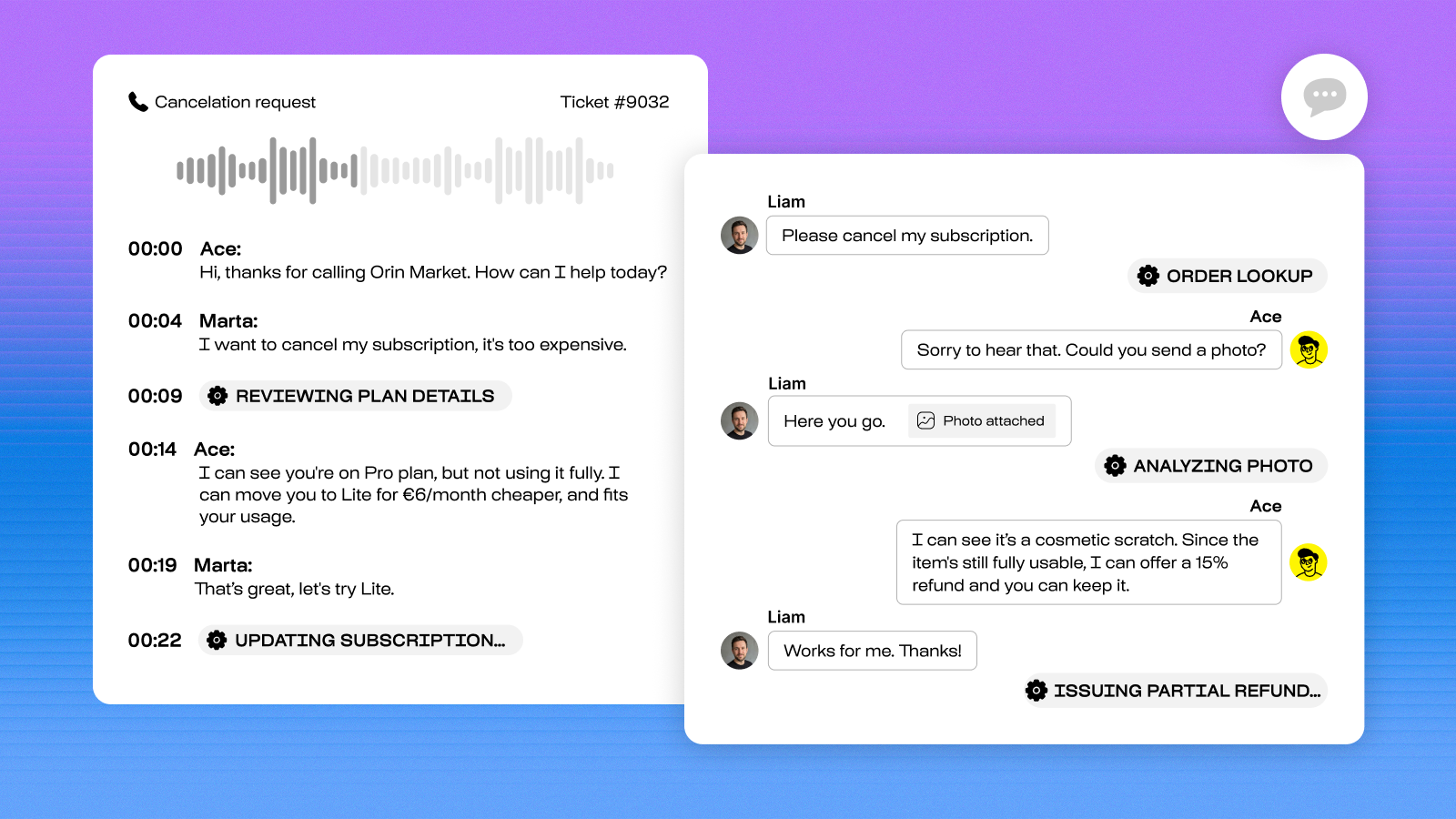
Free to reason, not free to overstep
We do not hand the agent a route. We define the territory it is allowed to move through and where it needs to get to, and the agent works out the way itself, reading the case, checking your systems, deciding what to do next based on what it actually finds.
It is the difference between a new hire told to use their best judgment with no idea where the limits are, and an experienced rep who knows the policies and works the rest out for themselves.
The right agents for each case
There is no single general-purpose assistant trying to do everything. The work is split across many purpose-built agents, each with a narrow job and access only to the knowledge and tools that job requires. Nothing is built in advance for a specific request either. When a conversation comes in, the system assembles the agents and procedures that particular case needs. A refund dispute and a subscription change draw on the same components in completely different combinations.
Autonomous, but not independent
That is the phrase we keep coming back to internally. The agents genuinely reason and decide. What they cannot do is act outside the boundaries you have set, and when a case needs judgment that is not theirs to make, it goes to a person with the full conversation, the reasoning and a recommended next step already attached.
Scales without collapsing
Because a graph adds a path rather than another instruction, everything that already worked keeps working. That is the whole reason automation rates hold as scope grows rather than drifting once the easy cases run out.
Nothing is a black box
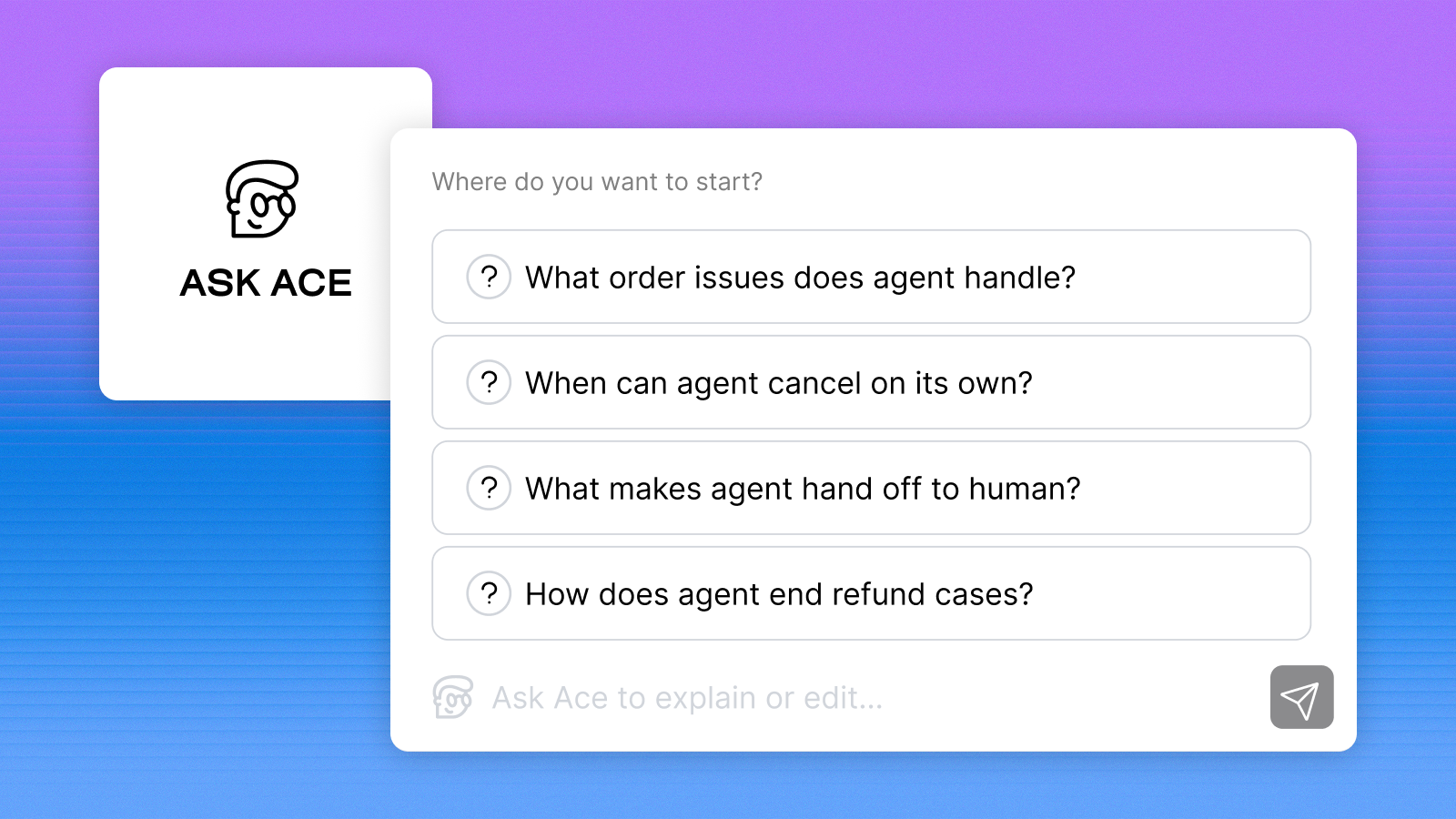
Every decision is logged: what the agent read, what it checked, what it did, and why. Ask Ace, the built-in AI assistant, will explain any path an agent took in plain language, and turn a procedure you describe in plain language into a working one.
 Changes run against real APIs in Sandbox before they reach a customer, and Simulations test behaviour before launch and on a schedule afterwards.
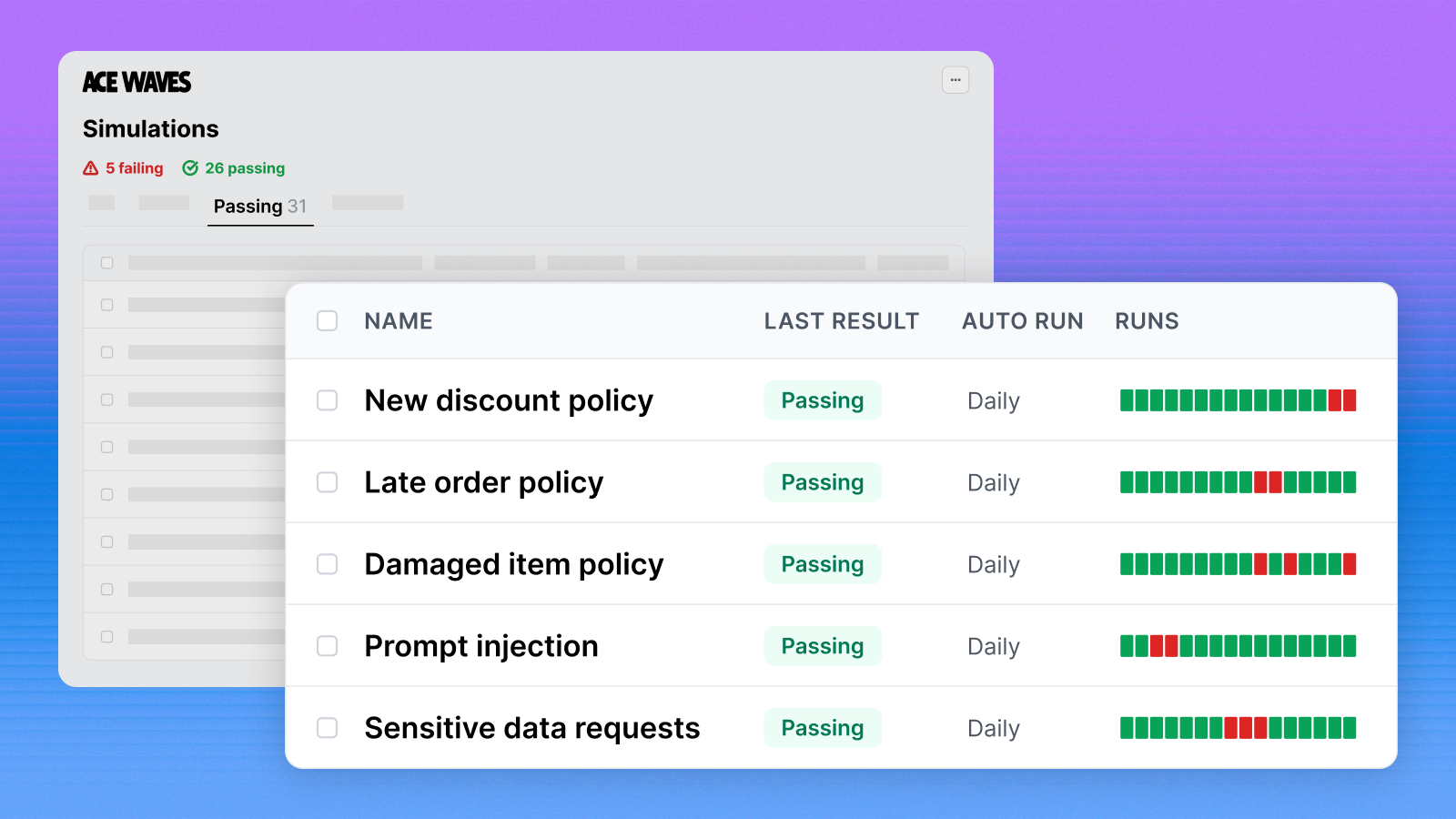
Handing your customers to an AI agent is a serious decision. It should be something you can verify rather than something you have to put blind faith in.
Secure by design
Transparency is one half of that, and security is the other. Ace Waves is ISO/IEC 27001:2022 certified and has completed a SOC 2 Type 1 examination for Security. Your data is hosted in the EU, encrypted at every step from transit to backup, and never used to train models. Being built and hosted in the EU is also what makes GDPR and the EU AI Act structural for us rather than retrofitted. And we stay model agnostic, so you run on the models you trust rather than the ones we happen to have picked.
You can read more in our Trust Center.
Why it works in production
Agent Graph is the technology, and technology on its own does not run a support operation. We combined four essential elements to make it work, and together they are what the results below rest on.
Agents that reason freely inside your procedures and never outside them. That is the graph, and it is the part we have just described.
Integrations that let them do the real work inside your systems. Helpdesk, CRM, order management, billing and payment tools, with native integrations for the most common ones and custom ones where you need them. Nothing gets ripped out and replaced.
Every channel your customers use. Voice, chat, email, messaging, social, and even WhatsApp, in more than 90 languages. A procedure is built once and runs on all of them, so when the policy behind it changes you update it in one place rather than in four versions of it.
Outcome-based pricing. You pay only for the work the agents actually do, not for conversations that get deflected.
Built for you, controlled by you
None of it arrives as a tool for you to configure. Our Forward-Deployed Engineers do the build: engineers and product managers working next to your own people, mapping how the operation actually runs rather than how the handbook says it does, preparing your support, retention and sales procedures for AI agents, handling the integrations and running the rollout. You stay in full control without anyone on your side needing to become an AI expert.
The results
Across our clients, Agent Graph reaches up to 87% automation, cuts cost to serve by up to 60%, and lifts retention by 15%.
Eneba saves €1M a year. Reloe hit 72% automation in its first week and 84% in its second. Pulsetto went live in two weeks and absorbed double its Black Friday volume without hiring anyone. Honeygain went from 46% to 80% CSAT after moving off a self-serve AI tool.
First agents handle real conversations in two to four weeks rather than after two quarters. Procedures are built once and reused rather than rewritten, and our agents arrive already knowing the cases their industry has in common, so we are not spending the first month teaching a system what a refund is.
We taught customer service AI to make money
This is the part I find most exciting.
Support is where customers tell you they are leaving, and almost every company just processes that conversation. Not because nobody noticed the opportunity, but because an agent with three hundred conversations waiting behind this one cannot afford to ask a second question. Understanding why someone is cancelling takes time, and time is the thing a support operation has never had.
AI agents are not under that pressure. Ours resolve the cancellation end to end, work out why it is happening, and make the offer your policy allows.
A cancellation gets saved instead of processed. A refund becomes a replacement. A customer who has just been helped is asked for a review while they still feel good about it, or offered the thing that genuinely fits. These are just a few examples of where revenue can be defended or earned.
Consider what your marketing team spends its budget on: buying the attention of people who never asked for it. Support gets that attention thousands of times a day, for free, from customers at the moment they are most honest and closest to leaving. The only reason it never produced revenue is that you could not afford to staff it that way.
Which is why lower cost to serve is the least interesting thing about this. Cheaper is a cost programme. This is a growth channel. Those two things go to very different meetings inside a business, and they carry very different budgets.
The cost center era is ending
For as long as anyone has been in business, customer service has been something painful and expensive. That arithmetic has changed. It is time customer service started making money instead.
Agent Graph is the technology making it possible, and it is running in production today. If you are interested – let's chat.
The chatbot hangover is finally over.