By Antanas Bakšys, CEO & Co-Founder of Ace Waves
Why customer service gets more expensive, more inconsistent, and harder to automate as you scale – even after more hires, more tools, and more AI.
Key ideas (TL;DR):
Customer Service Debt (CSD) is a compounding set of hidden customer service problems a company has ignored, patched up, or compensated with more people, more tools, and more manual work instead of fixing the root causes.
Similar to technical debt, it has a principal (missing foundations) and an interest (daily cost of patching around it).
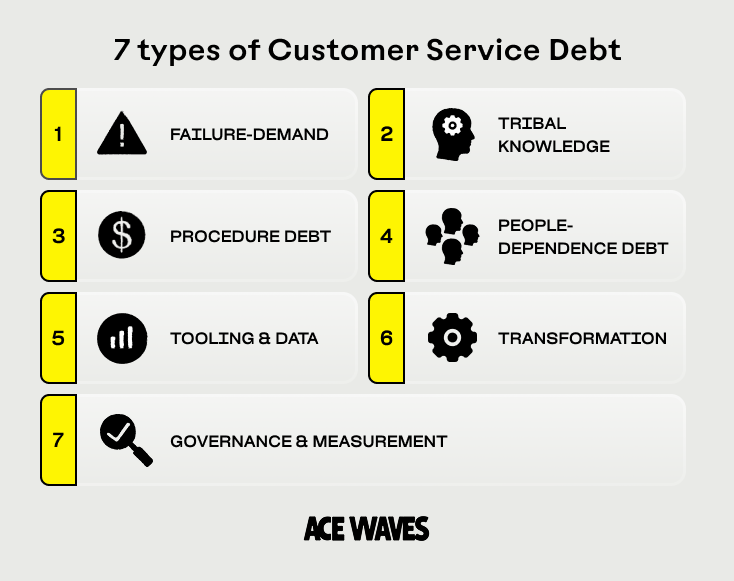
There are 7 CSD types: failure-demand, tribal knowledge, procedure, people-dependence, tooling, data & integration, transformation, and governance & measurement debt.
It’s hidden because every function sees a different symptom – rising cost, weaker retention, stalled automation, inconsistent decisions – and no single team owns the full picture.
More hires, more tools, and more AI don’t pay down the debt – rather, they scale the inconsistency underneath.
You can only deploy AI automation successfully once Customer Service Debt is solved. Without solid foundations, AI inherits the inconsistency and automates mistakes at scale.
How Customer Service Debt shows up in a single support issue
Let’s walk through a typical customer service case: a customer contacts support about a refund. The case looks simple: an agent opens the helpdesk, checks the order status, finds no flag, and looks for the refund policy. That policy lives in a shared doc nobody has updated in eight months. The agent makes a judgment call, applies a partial refund, and closes the ticket.
A week later, the same customer returns. The refund never reached their account, and now they are frustrated. The case is now harder: the agent handling the follow‑up has to dig through previous messages, check the order system, check the payments system, and then ask someone in finance what actually happened.
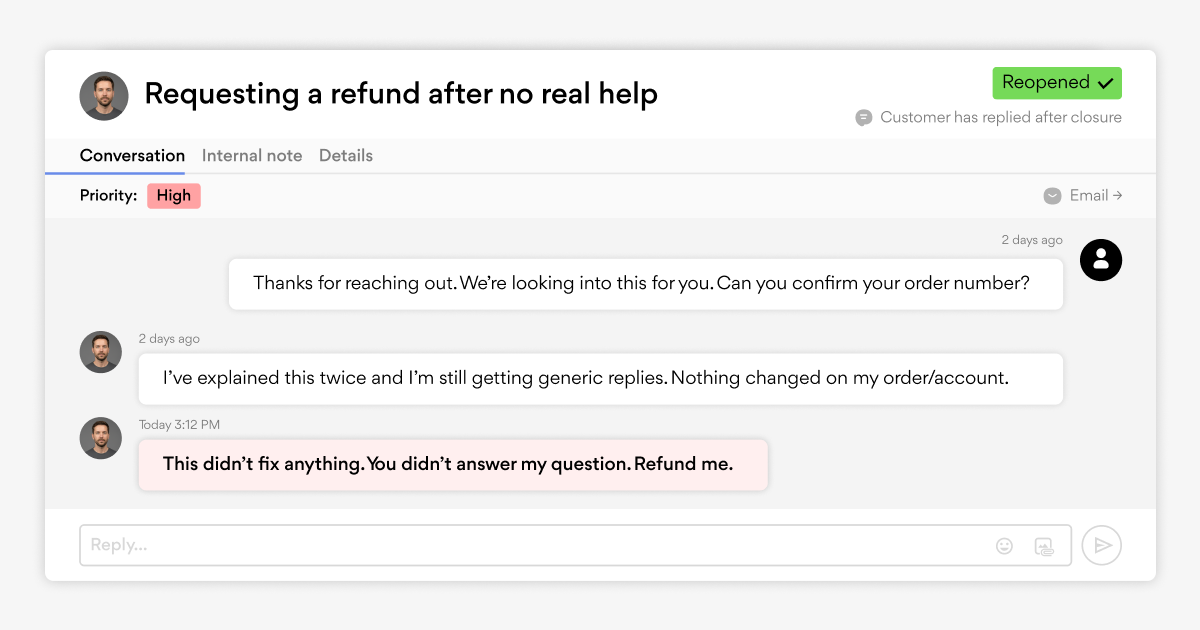
It turns out the refund was noted in the helpdesk, but was never executed correctly in the system that actually sends money. The agent fixes it, but not before the case is reopened, escalated, and handled twice.
This kind of fragility is more common than most leaders realize – and more expensive than most P&Ls show.
Companies that feel it tend to share a few similarities: they have grown quickly, operate across multiple markets or brands, work with legacy tooling and tribal workflows, and run customer service operations that already touch retention, margin, or trust in some direct way.
In these environments, the real process is rarely stored in one clean source of truth. Logic lives in people, habits, shared notes, and the institutional memory of whoever has been around longest. This creates a gap for structured and clearly defined procedures that neither work in practice nor can be efficiently automated and integrated with tools.
At Ace Waves, after building AI agents for B2C companies for over a year, we started calling this pattern Customer Service Debt.
What is Customer Service Debt?
🌊 Customer Service Debt (CSD) is the compounding set of hidden customer service problems a company has ignored, patched up, or compensated with more people, more tools, and more manual work instead of fixing the root causes.
The name is deliberate. In software engineering, technical debt describes the cost of choosing the quick path over the correct one. Similar to technical debt, CSD has:
The principal – the customer service foundation the business never built or outgrew: missing procedures, fragmented systems, tribal knowledge, unclear decision authority.
The interest – what the company pays every day to keep things running despite those missing foundations: inconsistency, slower resolutions, stressed teams, rising costs, and an experience that erodes customer trust even when headline metrics look acceptable.
What makes this particular form of debt hard to name is that the company can still serve customers while carrying it: orders still get processed, tickets still close, customer satisfaction scores can stay reasonable.
But the cost of producing those outcomes keeps rising, because the operation is patching around root causes instead of removing them:
More volume of work is created by inefficient workarounds.
More hires absorb volume but introduce more variance.
More tools add capability but also complexity.
More macros speed up replies without improving what actually happens to the customer’s underlying problem.
This debt is the primary driver of most modern customer service challenges, making the adoption of AI in customer support feel like a patch rather than a solution.
The debt quietly accumulates.
How different leaders see the same Customer Service Debt:
The CEO sees trust and retention leaking: customers who contact support more than once for the same issue, CSAT doesn’t move despite investment, and a customer service operation that starts appearing in strategic conversations for the wrong reasons.
The CFO sees cost growing faster than correct outcomes: headcount grows to match volume, software spend expands, but "resolved" in the helpdesk hides repeats, mistakes, escalations, and cleanup – so the real cost per correct resolution keeps rising even when the dashboard looks stable.
The COO sees operations built on firefighting rather than repeatable systems: every peak exposes fragility, every quiet period gets consumed by cleanup instead of improvement.
The Head of Customer Service sees a queue that refills regardless of how hard the team works: a constant stream of exceptions, escalations, and cases that should have been simpler.
The CTO sees disconnected systems producing no reliable way to enforce correct outcomes: pressure builds to automate, but the foundations are not there to automate against.
Head of Product sees recurring customer issues and noisy feedback that consistently fail to translate into improvements, because the signal is buried in operational noise.
Risk and Compliance sees inconsistent decisions and no clean audit trail: different agents reach different conclusions from the same facts, and there is no mechanism to govern that at scale.
The VP of Sales and CMO sees untapped revenue-driving opportunities. They have ideas to improve retention and upsells, but no way to implement them because the customer support team lacks the specialized skills and the headspace to do anything more than survive the backlog.
The commercial impact shows up across functions, which is also why it is hard to fix. No single team owns the full picture. And because every function sees a different piece of it, it rarely gets named as one problem.
The seven types of Customer Service Debt: the driver of customer support challenges
Most of the cost in a struggling customer service operation does not come from one broken thing. It comes from several of them operating simultaneously – each adding friction, each generating rework, each making the others harder to fix.
The seven types below are the specific structural gaps that produce compounding costs and most customer service challenges.
1. Failure-demand debt
🌊 Failure-demand debt – customer contact volume that did not need to exist, caused by product issues, operational failures, or inconsistent customer support execution.
A customer cannot find the invoice breakdown, so they write in. A delivery notification never arrived, so they asked for a status. A billing charge looks incorrect because the line item description is unclear. The issue does not have to be a system failure – a confusing UI, an ambiguous policy, or a missing confirmation email is enough to generate a ticket.
These contacts are triggered by issues and gaps: billing errors, delivery problems, unclear UI, policy gaps, and communication failures. They land in the queue, consume capacity, and inflate cost without producing new value. As the business scales, these issues generate more contacts, increasing the cost even further.
Most businesses undercount failure demand because their helpdesk measures contact volume, not contact cause – so avoidable contacts get handled the same way as genuine ones, and the upstream trigger never gets fixed. The customer service team absorbs these issues case by case, which prevents the organization from seeing how often the same problems occur.
How it shows up:
A large share of contacts are low-complexity (“Where is my order?”, “How do I…”).
The same issue keeps arriving from different customers in predictable waves.
Volume spikes during releases or promotions, driven by the same underlying cause.
Product and customer service teams have no shared feedback loop that actually closes.
Agents recognize patterns but develop workarounds instead of seeing issues fixed upstream.
2. Tribal knowledge debt
🌊 Tribal knowledge debt – when critical know-how resides in people rather than in documented procedures and systems.
In most operations that have grown quickly, the real process lives in people: specific agents, specific supervisors, the person who has been there since the beginning. The knowledge is not documented or embedded into systems, so new agents learn by asking others instead of following a consistent process.
When experienced team members leave or are unavailable, the gap becomes a problem: new agents cannot replicate what they have not been taught → consistency drops → training costs rise → the operation becomes increasingly dependent on specific individuals.
How it shows up:
New agents’ main source of truth is more experienced agents.
Manager intervention is required for situations that should be routine.
Resolution quality varies by tenure.
Resolution slows down as agents rely on others to make decisions.
Experienced reps carry a disproportionate share of complex cases.
3. Procedure debt
🌊 Procedure debt – a situation when processes exist in some form: a doc, a macro, a training deck, but have not been maintained to reflect how the business actually operates today.
A policy gets updated in a meeting, but not in the macro. A product changes, but the training deck from eight months ago is still what new agents read in their first week. An exception gets approved by a manager once, and that exception becomes an informal precedent for everyone who was in the room.
The documented procedures fall behind how the business actually operates, so agents work with outdated information, leading to avoidable errors in the process, costing the business lost clients, poor reviews, and additional expenses, not to mention accumulating tickets from second-return clients if something went wrong.
How it shows up:
Two agents handle the same case differently, both believing they followed the correct process.
Documentation references policies that no longer exist or are outdated.
Long internal back-and-forth on basic cases, slowing down resolution.
Escalations arrive not because cases are complex but because agents are unsure what they are allowed to do.
Similar cases result in different commercial outcomes.
4. People-dependence debt
🌊 People-dependence debt – when customer outcomes depend on individual judgment rather than a controlled, repeatable system.
Human agents interpret policies differently, take different levels of risks, or make human errors influenced by experience, risk tolerance, personal judgment, or mood, and reach different outcomes for the same case.
Tribal knowledge and procedure debt are about where the process lives. People-dependence debt exists because humans are inherently inconsistent. Even with the same information, two agents can reach two different decisions. The result: inconsistent customer experiences, unpredictable costs, and exposure to risk.
How it shows up:
The same case gets different resolutions depending on the agent.
Customers escalate to get a different or more favorable outcome.
High variance in outcomes across agents or teams.
Human errors and policy deviations occur regularly.
Agents struggle to execute complex workflows quickly and without mistakes.
Quality improves only when specific supervisors are involved.
5. Tooling, data, and integration debt
🌊 Tooling, data, and integration debt – when systems are not connected, data is unreliable, and actions cannot be executed seamlessly within the customer support workflows.
It covers three related problems that tend to appear together:
Fragmented systems: the helpdesk, order management platform, subscription tool, payment processor, and internal databases operate in silos, so agents manually bridge the gaps.
Unreliable data: decisions get made on incomplete or lagging information because the helpdesk does not reflect what the source systems actually show.
Limited execution: the tools in use – often basic chatbots or early-generation automation – can retrieve information but cannot take action, so resolution still requires a human to complete the work the system started.
Every new channel, market, or volume step-up makes it more expensive. Manual context-gathering, copy-paste between tools, and status checks that should not exist multiply with scale and work that could be automated stalls because the data or integrations are not there to support it.
As a result, context is fragmented, and decisions are made without a complete, consistent view. Resolution slows down as agents spend time gathering context and executing actions manually, increasing cost per case.
Manual steps increase the risk of errors and inconsistencies, and actions become harder to trace across systems. Without a clear record of what happened and where, issues are harder to diagnose, and rework becomes the default response.
How it shows up:
Agents switch between multiple tools to get context and complete actions.
Manual status checks are routine.
Copy-paste between systems is a normal part of the workflow.
Data in the helpdesk lags behind data in the source systems.
Actions that should be executable by the system still require human intervention.
6. Transformation debt
🌊 Transformation debt – when customer service scales through hiring and workarounds instead of system-level improvements and automation.
As volume grows, the organization adds people to handle the load rather than fixing the underlying workflows. It is the path of least resistance – a new hire solves this week’s problem without requiring a process decision, an integration, or a procedure change.
The cost compounds in two directions. More people introduce more variability, more coordination overhead, and more training burden. And because the system never gets fixed, each growth step requires another round of hiring to absorb the next wave of volume. Obvious workflow improvements stay in the backlog because the team is too busy handling the load to reduce it.
It also reflects a behavioral pattern: teams choose hiring and workarounds over bigger changes, including automation or AI, because they feel safer and more predictable. Past failed attempts, skepticism toward AI, and fear of disruption or failure make structural change easier to delay than to execute.
When the company eventually tries to automate or modernize, it finds an operation built around people compensating for a system that was never designed to scale, which makes the change harder, slower, and more expensive than it needed to be. AI adoption gets delayed not only because the system is not ready, but also because the organization has adapted to working around the problems instead of fixing them.
How it shows up:
Headcount is growing faster than customer support volume.
Hiring is the default response to rising ticket load.
AI or automation initiatives are repeatedly delayed or deprioritized.
Workflow improvements are staying in the backlog for months.
New tools are adding steps rather than removing complexity.
Costs and coordination overhead are rising without proportional gains in efficiency or consistency.
7. Governance and measurement debt
🌊 Governance and measurement debt – when there is no clear ownership, shared definitions, or reliable measurement of customer service outcomes.
It covers two problems that compound each other:
The measurement side: there are no shared definitions for outcomes, quality, or ROI. Each team tracks what suits them, dashboards contradict each other, and decisions get made on assumptions instead of a shared truth.
The governance side: nobody owns the outcome end-to-end. Customer service, operations, product, and IT each hold a piece of the picture, and when something breaks or needs improving, accountability diffuses across all of them.
As a result, improvements take longer because there is no clear operating cadence and no single owner to drive them through.
How it shows up:
"Resolved" and "done" mean different things depending on who you ask.
The same performance questions are debated repeatedly without resolution.
Ownership of customer issues is fragmented across support, operations, product, and IT.
Dashboards are not trusted by the people closest to the work.
Automation metrics show strong numbers while cost-to-serve keeps rising.
No regular cadence for reviewing and improving workflows.

Why scaling customer service is hard
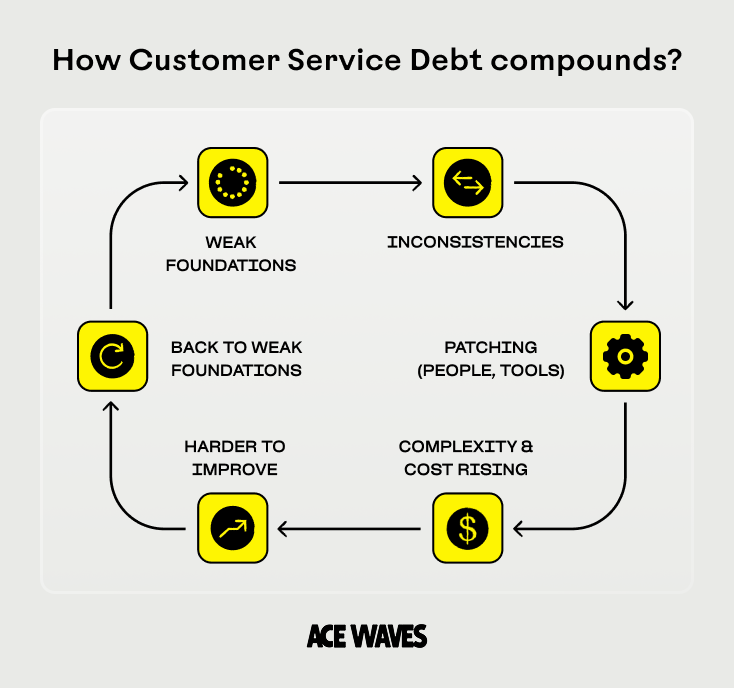
The short answer: Customer Service Debt. Scaling customer service is not an easy task because CSD does not start with one dramatic failure – it compounds. The mechanism is quiet.
It begins with weak foundations: undocumented or half-documented procedures, fragmented tools, tribal knowledge sitting with a handful of strong reps, unclear ownership of edge cases, teams optimizing for ticket closure rather than correct outcomes. At first, the company patches over those gaps. More agents absorb volume. More tools add capability. More macros speed up common responses. More manager oversight catches exceptions before they become complaints.
That can keep things running for a while, but every patch adds complexity. And complexity raises cost, increases inconsistency, and makes future improvement harder. Over time, the company spends more energy coping with the system than improving it.
The loop looks like this: Weak foundations → inconsistencies → patching with people and tools → growing complexity and cost → shrinking ability to improve → weaker foundations
The result is what we call the second backlog – the one that never appears in reports.
🌊 Second backlog is the hidden interest on your Customer Service Debt. It consists of repeat contacts, reopens, and escalations that occur because the first interaction didn’t actually resolve the underlying issue.
Repeat contacts from customers who were not actually helped the first time. Reopened tickets from resolutions that did not stick. Escalations that should have been handled at the first touch. Exception queues and manual cleanup that eat into the time the operation needed to get better. The first backlog is visible – the second one is where the debt actually lives.
What it looks like in day-to-day work
The backlog never really drains.
Reopens and repeat contacts start feeling normal.
Escalations stay high despite more hires.
The same issue gets different outcomes depending on who handles it.
Managers spend more time triaging than improving.
Strong reps or specific supervisors carry too much of the operation.
Agents use workarounds as the real process.
Issues bounce between teams without clear ownership.
New tools speed up replies but not completion.
Obvious workflow fixes sit in the backlog for months.
… and the list continues.
Why do more people, more tools, and more AI often fail to solve customer support challenges?
The company sees rising costs and inconsistent outcomes. The response is reasonable: hire more agents, implement new tooling, run an AI pilot. In the short term, things improve: volume is absorbed, response times drop, and that pilot looks promising in a demo environment.
But a few months in, the improvement line flattens out. Cost is still climbing, inconsistency remains, and the customer support AI tool pilot is being reviewed. All three stall when the underlying system cannot contribute to consistent resolutions.
Understaffing is a capacity problem, while Customer Service Debt is a system problem.
A company can be fully staffed and still carry heavy debt. In fact, hiring into a weak system can increase variance rather than reduce it, because more agents mean more individual judgment, leading to more inconsistency, unless the procedures and controls that govern that judgment are solid.
There is a useful way to frame what most tooling actually delivers: reply tools reduce typing, and execution systems reduce work return. Most customer service software – including most AI implementations – operates in the first category. It makes replies faster, better-worded, and more consistent in tone.
What it does not do is change system state: process the refund, apply the cancellation, update the account. When the gap between reply and execution stays open, the second backlog keeps growing regardless of how good the tool looks in a demo.
Customer support AI without procedures, validation outside the model, and explicit escalation logic automates inconsistency and mistakes. A model that generates a confident-sounding response without knowing when to stop and escalate creates the same failure mode as a human agent who guesses instead of asking. The error just arrives faster and at a greater scale.
The company ends up paying around the debt with labor, software, and management attention instead of reducing customer service costs at the root. The loop continues, and the debt compounds.

The Ace Waves Insights Newsletter
Quality insights on AI and customer service. Thoughtful, useful, never promotional.
How AI in customer support helps pay down Customer Service Debt
Paying down Customer Service Debt isn’t a software problem – you can’t buy your way out of it with another tool, and you can’t hire your way out of it by adding more human agents. That work can’t be shipped as a product; it has to be built with the team that owns the operation.
That’s the model we built Ace Waves around. We combine an AI agent platform with a Forward-Deployed delivery model. Agent Graph is our flagship technology powering our platform. It’s our own core technology that turns your support operations into a visual system of specialized agents. The Ace Waves platform is where the agent get built. The Forward-Deployed model is how they get deployed.
A dedicated team of Forward-Deployed Engineers and Product Managers embeds directly with the customer’s CS and technical teams, to drive specific business outcomes together. The work does not end at go-live. It ends when the operation runs reliably, workflows are covered, and the system can be improved without rebuilding from scratch each time.
The embedded team focuses on four things:
Working directly with the customer’s team to map real workflows, identify gaps, and align on the business outcomes that matter: automation coverage, resolution quality, retention, and customer satisfaction.
Encoding that logic into Agent Graph: the procedures agents reason over, the conditions for escalation, and the policy limits they cannot cross.
Integrating AI agents into existing systems – helpdesk, order management, billing, subscription platform – so they execute actions end-to-end rather than generate replies.
Building performance monitoring and quality controls: checks, dashboards, and escalation paths that make the system auditable and improvable over time.
When a procedure changes – a new policy, a new market, a new edge case – it is updated centrally in the Agent Graph and applies immediately across production. No retraining cycle, no risk of the update reaching some agents but not others.
What changes after deployment
Most work is completed end-to-end by AI agents, with only edge cases escalated to your team
Outcomes become consistent across agents, shifts, and channels
Resolutions become predictable and controlled, no longer dependent on individual judgment
Dependency on specific people decreases as decision logic is embedded in the system
Customer service cost decreases as manual work is removed rather than scaled with volume
Core business metrics improve: retention rises, cancellations decline, CSAT increases
Customer service becomes a scalable operational capability rather than a collection of workarounds
Where automation should stop
Automation should aim for the highest level of correct and safe resolution, not 100% coverage. This is why.
Pushing automation beyond its safe boundaries produces errors, hallucinations, inconsistent outcomes, and – eventually – loss of customer trust. Defined boundaries are what make the system reliable at scale.
Automation should stop when: customer identity cannot be confidently verified; required data is missing or unreliable; actions are irreversible and cannot be validated; there is no clear procedure or decision criteria; a case falls outside known workflows or into unknown edge cases; human judgment is genuinely required.
These boundaries are defined in the system, not left to agent discretion or to the model’s own confidence estimation.
Incorrect automation increases cost and complexity, even if the automation rate metric looks high. A system that completes most of the cases correctly and escalates the rest is more valuable than one that attempts to clear them all but produces unreliable outcomes. The goal is correct resolution, not maximum automation.
What paying down Customer Service Debt looks like in real cases
If you’d like to get an evaluation of your Customer Service Debt from our expert team, you can book a consultation here.
If you want to read real companies’ stories – start with Reloe and Pulsetto.
Frequently asked questions
1. What is Customer Service Debt?
Customer Service Debt (CSD) is the compounding set of hidden customer service problems a company has ignored, patched up, or compensated with more people, more tools, and more manual work instead of fixing the root causes.
2. What are the 7 types of Customer Service Debt?
Failure-demand debt
Tribal knowledge debt
Procedure debt
People-dependence debt
Tooling, data, and integration debt
Transformation debt
Governance and measurement debt
Each type has distinct symptoms and distinct consequences. Learn more
3. How do you know if your company has Customer Service Debt?
CSD shows up as a range of symptoms and common customer support challenges: inconsistent outcomes, unclear procedures, dependence on specific people, repeated issues driven by product or process gaps, and systems that require manual workarounds to complete real customer work. If you recognize these patterns in your operation, you likely have Customer Service Debt.
Ace Waves can help you evaluate where the debt lives and what it is costing you:
4. How is Customer Service Debt different from just being understaffed?
Understaffing is a capacity problem. Customer Service Debt is structural – adding people to a weak system increases cost and complexity without improving consistency or outcomes, and can increase variance if the procedures governing how work gets done are not solid.
5. How does Customer Service Debt affect cost and business performance?
Customer Service Debt hits cost, revenue, and strategic capacity at the same time. The real metric to watch is cost per correct resolution – not cost per ticket and not time-to-first-reply. Companies pay for the same issue multiple times through repeats, reopens, escalations, and cleanup. Revenue leaks too: through inconsistent decisions, resolution delays, and churn triggered by customers who stopped trusting the process. And strategically, Customer Service Debt blocks AI adoption and transformation: pilots stall against weak foundations, improvements compete with firefighting, and leadership can’t forecast capacity or prove ROI.
6. Can AI alone solve Customer Service Debt?
No. AI in customer service can assist with responses, but without fixing procedures, data reliability, and system execution, it will not close the gap between intended and actual service delivery. Automating against a weak foundation scales the inconsistency. Fixing the foundation first – through a Forward-Deployed model that turns messy operations into a consistent, executable system – is what makes AI work in production.
7. What is Forward-Deployed Engineering?
Forward-Deployed Engineering is a delivery model where senior Ace Waves engineers and product managers embed directly inside a customer’s operation to build, implement, and continuously improve systems in production. The engagement goes beyond tool configuration and handover – they take ownership of outcomes end-to-end: integrating with real systems, handling edge cases, and ensuring the solution delivers measurable business results.
8. Isn’t Forward-Deployed Engineering just professional services or customer success with a different name?
No. Professional services deliver scope, while customer success consults and recommends. Forward-Deployed delivery takes ownership of outcomes inside the actual operation.
9. Who created the term Customer Service Debt?
The term was coined by Ace Waves, based on patterns observed while deploying customer service AI agents for consumer brands. It’s an extension of the technical debt analogy applied to customer service operations.
The Ace Waves Insights Newsletter
Quality insights on AI and customer service. Thoughtful, useful, never promotional.